

Late-summer energy bills often rise because continued heat and humidity keep air conditioners running longer. Dirty filters, blocked airflow, dirty coils, leaky ducts, thermostat settings, or developing equipment problems may add to that workload.
For Rhode Island and Massachusetts homeowners, August and early September can still bring humid days and warm nights. Cooling equipment may also have been operating heavily for several weeks by that point.
A higher bill does not prove that the air conditioner is failing. Utility rates, billing-period length, household schedules, appliance use, and outdoor weather may all affect the total.
Why do energy bills spike in late summer?
Energy bills often spike in late summer because air conditioners run longer during repeated hot and humid conditions.
Common reasons include:
- Longer daily cooling cycles
- Warm nights with limited recovery time
- High indoor and outdoor humidity
- More people spending time at home
- Dirty or restrictive filters
- Blocked vents or return grilles
- Dirty indoor or outdoor coils
- Leaky ducts
- Air leakage around the home
- Large thermostat changes
- Aging or damaged equipment
- Refrigerant, electrical, or airflow problems
Neglected air conditioner maintenance reduces performance and increases energy use. Filters, coils, fins, and refrigerant lines are among the maintenance areas that affect operation.
It’s important to compare energy consumption and not only the dollar amount. A higher bill may reflect more kilowatt-hours, a longer billing period, a new rate, or several factors at once.
How does New England humidity affect cooling costs?
Humidity can increase cooling demand because an air conditioner must remove moisture as well as heat.
During humid weather, homeowners may notice:
- Longer cooling cycles
- Rooms that feel sticky
- Uneven comfort between floors
- Cooling that continues into the evening
- Condensation on some surfaces
- A desire to lower the thermostat for comfort
Rhode Island and Massachusetts homes may move from wet spring weather into humid summer conditions with a short shoulder season between them. Older houses, additions, finished attics, and altered duct systems may also cool unevenly.
Lowering the thermostat may not solve an underlying humidity or airflow problem. Equipment sizing, drainage, duct condition, and system operation may need professional evaluation.
What should homeowners check when cooling costs rise?
Homeowners should first review electricity use, the HVAC filter, thermostat schedule, indoor airflow, and visible outdoor clearance.
Use this safe checklist:
- Compare electricity consumption.
Review kilowatt-hour use, billing days, and recent household changes. - Check the filter.
Replace or clean it when dirty and follow the equipment instructions. - Check supply vents and return grilles.
Move furniture, rugs, curtains, and boxes that restrict airflow. - Review thermostat schedules.
Avoid repeated large changes during the hottest hours. - Close doors and windows.
Look for damaged weatherstripping or obvious gaps. - Check outdoor clearance.
Remove loose leaves and light debris without opening the unit. - Note performance changes.
Watch for weak airflow, ice, leaks, unusual sounds, or frequent cycling.
Safety note: Do not open electrical compartments, remove guards, handle refrigerant lines, or attempt internal mechanical repairs.
Can a dirty air filter increase an energy bill?
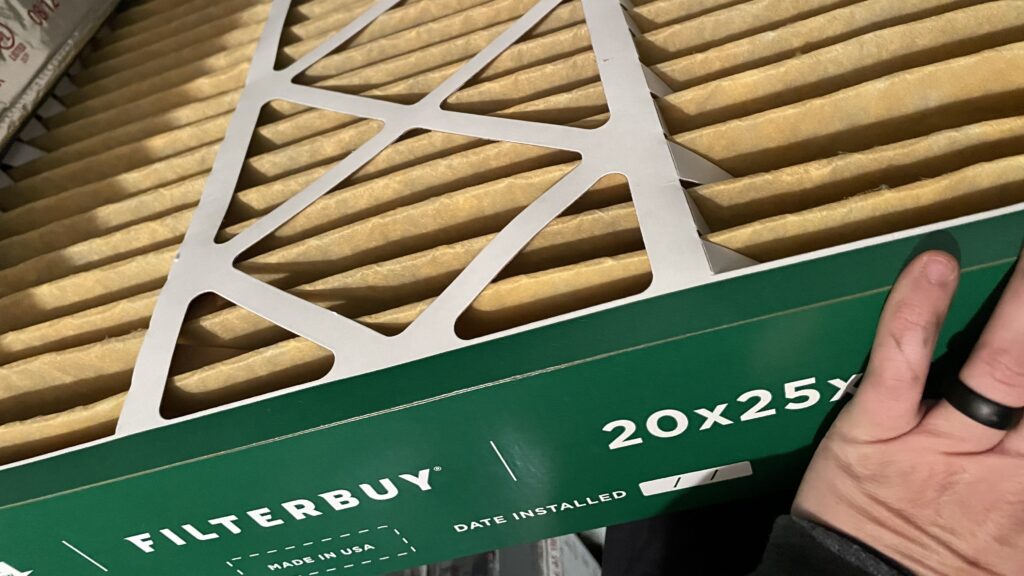
A dirty air filter can contribute to higher HVAC energy use because restricted airflow makes the equipment work harder.
A filter may collect:
- Dust
- Pet hair
- Pollen
- Fibers
- Renovation debris
- Other household particles
ENERGY STAR recommends checking the filter monthly during heavy-use periods and replacing it when dirty. At minimum, it’s recommended to replace it every three months, although the correct schedule depends on the system and filter.
Do not assume that the thickest or highest-rated filter is best. A filter that does not suit the equipment may restrict airflow.
Why might an air conditioner run constantly?
An air conditioner may run constantly because of severe weather, high humidity, restricted airflow, air leakage, duct problems, or a mechanical issue.
Possible causes include:
- Dirty filters
- Blocked or leaking ducts
- Dirty coils
- Thermostat problems
- Incorrect refrigerant charge
- Poor insulation
- Air leakage
- Debris around outdoor equipment
- Worn components
- Incorrect equipment sizing
ENERGY STAR states that dirty coils reduce cooling ability, increase system run time and energy costs, and may shorten equipment life.
Long cycles during extreme weather do not always mean the system is broken. Concern grows when the equipment cannot reach the thermostat setting or continues to run heavily during milder conditions.
Can duct and home conditions increase cooling costs?
Leaky ducts and air gaps can increase cooling costs by allowing conditioned air to escape or outdoor heat and humidity to enter.
Possible signs include:
- Some rooms never cool evenly
- Upper floors remain warmer
- Airflow is weak at certain vents
- Utility spaces feel unusually cool
- The system runs for long periods
- Additions remain uncomfortable
Older homes in Providence, Newport, Boston, Worcester, Cape Cod, and other established New England communities may include a mix of original construction, additions, and updated HVAC systems.
Homeowners can safely check accessible weatherstripping and simple gaps. Concealed duct testing, sealing, and balancing should be handled by a qualified professional.
What thermostat habits can raise cooling demand?
Large thermostat changes and aggressive cooling schedules may increase system run time.
Practical thermostat habits include:
- Use a consistent schedule
- Avoid repeatedly lowering the temperature when the home does not cool quickly
- Keep lamps and heat-producing devices away from the thermostat
- Adjust schedules when household routines change
- Use vacation settings when appropriate
- Follow manufacturer guidance for heat pumps
A programmable or smart thermostat can help manage schedules, but it cannot correct dirty coils, leaky ducts, poor insulation, incorrect sizing, or a mechanical problem.
What signs mean the HVAC system needs attention?
An HVAC system needs professional attention when increased energy use appears with weak airflow, uneven cooling, leaks, ice, new sounds, or abnormal cycling.
Warning signs include:
- The home does not reach the thermostat setting
- Airflow has weakened
- Some rooms remain much warmer
- The system starts and stops every few minutes
- Water appears near indoor equipment
- Ice forms on accessible components
- A breaker trips repeatedly
- Grinding, squealing, rattling, or buzzing begins
- Burning or unfamiliar odors appear
- Indoor temperature rises while the equipment runs
Turn the system off if you see smoke, electrical arcing, or another immediate hazard. Do not repeatedly reset a tripping breaker. GEM offers 24/7 emergency HVAC and emergency electrical service.
Schedule service with GEM when the basic checks don’t explain the change in your cooling system
Can HVAC maintenance lower late-summer energy use?
HVAC maintenance may address conditions that contribute to inefficient operation, but it cannot guarantee a specific bill reduction.
A maintenance visit may include:
- Inspecting electrical connections
- Checking system controls
- Evaluating airflow
- Inspecting coils
- Checking condensate drainage
- Reviewing thermostat operation
- Checking refrigerant conditions when appropriate
- Identifying worn components
- Testing startup and shutdown
ENERGY STAR recommends annual preseason professional checkups, ideally before summer or winter demand increases.
Make Maintenance Easier with GEM’s Home Comfort Club
Routine cooling maintenance can help your system operate more efficiently and reduce the chance of an unexpected problem during hot weather.
Through GEM’s Home Comfort Club, members receive pre-scheduled maintenance visits, savings on service work, exclusive membership scheduling, whole-home coverage options, and support when issues arise.
It’s a convenient way to stay ahead of care for your air conditioner, heat pump, and other essential home systems while helping protect comfort and equipment performance.
When should the air conditioner be repaired?
AC repair may make sense when the failure is isolated, parts remain available, and the system otherwise cools the home reliably.
Repair may be practical when:
- The failed component can be replaced
- Major repairs have not become frequent
- The equipment remains properly sized
- Airflow and duct conditions are acceptable
- The system still provides even comfort
- The repair does not uncover a safety concern
Ask the technician:
- What failed?
- What caused the failure?
- Will the repair restore normal performance?
- What condition is the rest of the system in?
- Is the problem likely to return?
- Are parts still available?
When should replacement be considered?
AC replacement deserves consideration when major repairs repeat, important parts are unavailable, or the equipment no longer provides dependable comfort.
Replacement may be worth comparing when:
- Repair needs are becoming frequent
- A major component fails
- Refrigerant problems keep returning
- Comfort remains uneven
- The system is incorrectly sized
- Duct or electrical work is already required
- The homeowner wants different efficiency or control features
A new system will not automatically correct leaky ducts, poor insulation, air leakage, or incorrect sizing. Those conditions should be evaluated as part of the project.
What affects HVAC costs in Rhode Island and Massachusetts?
HVAC costs depend on the diagnosis, equipment, parts, access, ductwork, electrical needs, refrigerant, and project scope.
Common cost drivers include:
- Repair type
- Part availability
- Equipment capacity
- Efficiency level
- Refrigerant type
- Duct repairs
- Electrical work
- Thermostat or control upgrades
- Equipment access
- Permit and inspection requirements
- Installation testing
Older New England homes may have tight utility areas, additions, finished basements, or modified ductwork that affects the work.
What is the best next step when a late-summer bill rises?
Compare energy use, complete the safe checks, and schedule service when cooling performance has changed.
Use this final checklist:
- Review electricity use and billing days
- Check the HVAC filter
- Clear vents and return grilles
- Review thermostat schedules
- Close exterior doors and windows
- Check accessible weatherstripping
- Remove visible debris around outdoor equipment
- Note weak airflow, ice, leaks, or unusual sounds
- Schedule maintenance or repair if symptoms continue
Schedule service with GEM and get to the bottom of what’s making your home harder to cool
Frequently Asked Questions
Why do energy bills spike in late summer?
Energy bills can spike in late summer because air conditioners often run longer during continued heat and humidity. Dirty filters, blocked airflow, air leaks, dirty coils, or equipment problems may increase that workload.
Can a dirty air filter increase an energy bill?
A dirty air filter can increase HVAC energy use because restricted airflow makes the cooling system work harder. ENERGY STAR states that dirty filters slow airflow and waste energy.
Why is my air conditioner running constantly?
An air conditioner may run constantly because of extreme heat, high humidity, restricted airflow, dirty coils, leaky ducts, incorrect sizing, or a mechanical problem. Professional attention is appropriate when the system cannot reach the thermostat setting or continues running heavily during milder weather.
Can dirty coils raise cooling costs?
Dirty coils can raise cooling costs because they reduce heat transfer and cause the air conditioner to run longer. ENERGY STAR states that dirty coils may increase energy costs and shorten equipment life.
What HVAC checks can homeowners safely make?
Homeowners can safely check accessible filters, thermostat settings, supply vents, return grilles, doors, windows, and visible outdoor clearance. Homeowners should not open electrical compartments, remove safety panels, or handle refrigerant components.
When does a high energy bill mean the HVAC system needs service?
A high energy bill may point to an HVAC problem when it appears with weak airflow, uneven cooling, ice, leaks, unusual sounds, short cycling, or repeated breaker trips. The bill alone cannot diagnose the cause.
Can HVAC maintenance guarantee a lower energy bill?
HVAC maintenance cannot guarantee a lower energy bill because weather, utility rates, household use, and home conditions also affect costs. Maintenance may address airflow, cleanliness, drainage, and equipment conditions that contribute to inefficient operation.
Are HVAC rebates available in Massachusetts?
HVAC rebates in Massachusetts may be available through Mass Save for qualifying equipment and projects. Eligibility depends on the property, equipment, contractor, utility participation, program requirements, and available funding. GEM is a member of the Mass Save Heat Pump Installer Network (HPIN).
Are HVAC rebates available in Rhode Island?
HVAC rebates in Rhode Island may be available through Rhode Island Energy or Clean Heat Rhode Island for qualifying heating and cooling equipment. Eligibility depends on the equipment, home, program, installation, and current requirements. GEM is a member of the Clean Heat Rhode Island Heat Pump Installer Network.