

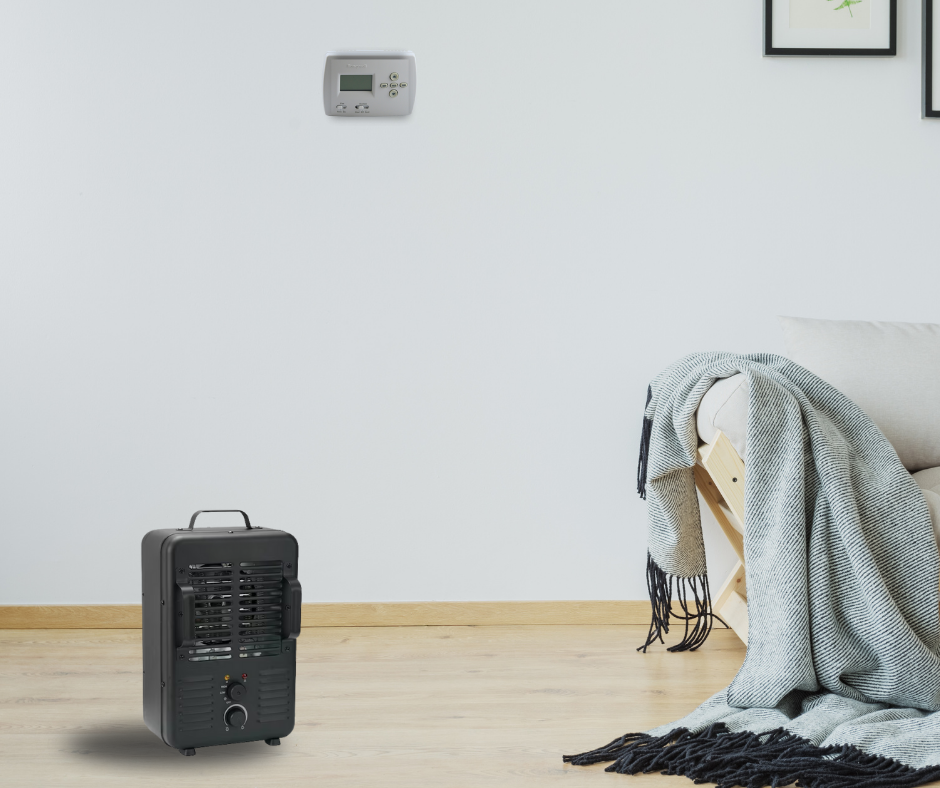
When winter weather hits New England, it hits hard. Between nor’easters, sub-zero wind chills, and older homes with uneven heating, many homeowners across Massachusetts, Rhode Island, and Connecticut turn to space heaters for quick relief.
At GEM Plumbing & Heating, we see a predictable spike in “no heat” calls during extreme cold. And surprisingly, a large number of those calls aren’t caused by a broken furnace or heat pump at all.
They’re caused by space heaters placed too close to thermostats.
This guide explains the proper use of space heaters, how they interact with your home’s heating system, and how to stay warm without accidentally preventing your HVAC system from doing its job.
How Space Heaters Are Meant to Be Used
Space heaters are designed for temporary, localized heating. They warm the air in a small area quickly, which makes them useful for:
- Drafty bedrooms
- Home offices
- Finished basements
- Short-term comfort during cold snaps
What space heaters are not designed to do:
- Heat an entire home evenly
- Replace a furnace or heat pump
- Run continuously during freezing weather
In New England homes — especially older colonials, capes, and multi-level layouts — improper space heater use can actually create new heating problems rather than solve them.
How Thermostats Read Temperature in Your Home
Most residential thermostats measure air temperature directly around the thermostat, not the average temperature of the entire house.
That means:
- If the air near the thermostat is warm, the thermostat assumes the home is warm
- The heating system will not turn on if the thermostat thinks the set temperature has been reached
This becomes especially important in New England homes with:
- Central hallway thermostats
- Open first floors
- Zoned systems
- Ducted or ductless heat pumps
Can a Space Heater Affect a Thermostat?
Yes — a space heater can absolutely affect a thermostat.
If a space heater is:
- In the same room as the thermostat
- Too close to the thermostat
- Blowing warm air directly toward it
…the thermostat may read a higher temperature than the rest of the home.
When this happens, the thermostat thinks the house is warm — even if upstairs bedrooms, bathrooms, or back rooms are still cold. As a result, your furnace or heat pump may never receive the signal to turn on.
This is one of the most common cold-weather issues GEM sees across Massachusetts, Rhode Island, and Connecticut, especially during prolonged winter storms.
Why Your Heating System Isn’t Turning On When a Space Heater Is Running
If your heater isn’t turning on while a space heater is running, it’s often because:
- The thermostat has reached its target temperature
- The heating system is responding correctly
- The temperature reading itself is inaccurate
In other words, the system isn’t broken — it’s being tricked by localized heat near the thermostat.
This issue is especially common with:
- Heat pump systems that rely on precise temperature readings
- Zoned systems where one area warms faster than others
- Homes where space heaters are used daily for comfort
No Heat—but the Thermostat Says It’s On? What to Check First
Before assuming a major HVAC failure, check these common issues:
- Is a space heater running near the thermostat?
- Is the thermostat located in a room where a heater is operating?
- Does the thermostat show “heat” (not fan-only)?
- Are some rooms warm while others are cold?
If the answer is yes to the first two questions, moving the space heater may immediately restore normal heating operation. Still no heat? Maybe it’s time to repair or replace your heating system.
Space Heater Safety Tips Every Homeowner Should Follow
Beyond thermostat issues, space heater safety is critical — especially during winter storms when heaters tend to run longer.
Basic space heater safety tips:
- Never leave a space heater unattended
- Keep heaters away from curtains, furniture, and bedding
- Plug heaters directly into a wall outlet (never a power strip)
- Turn heaters off when sleeping or leaving home
In tightly sealed New England homes, improper heater use can increase fire risk and strain electrical systems.
Where to Place a Space Heater Safely (and Where Not To)
Proper placement matters for both comfort and safety.
Good placement:
- In rooms without thermostats
- On flat, stable surfaces
- Away from walkways and traffic areas
Avoid placing space heaters:
- Near thermostats
- In hallways or stairwells
- Close to flammable materials
- In bathrooms or damp spaces
How Far Should a Space Heater Be from a Thermostat?
As a general rule, a space heater should be kept several feet away from a thermostat — ideally in a different room altogether.
This helps prevent:
- False temperature readings
- Uneven heating throughout the home
- Heating systems that don’t turn on when needed
If your home depends heavily on space heaters to stay comfortable, that’s often a sign your system needs professional attention.
When to Call an HVAC Professional Instead of Using Space Heaters
Space heaters can help temporarily — but they shouldn’t be your long-term heating plan.
Call a professional HVAC technician if:
- Your home won’t stay warm without space heaters
- Your heating system responds inconsistently
- Some rooms never reach the set temperature
- You’re concerned about safety or rising energy costs
GEM Plumbing & Heating provides expert heating service across Massachusetts, Rhode Island, and Connecticut, helping homeowners stay warm safely — even during the coldest New England winters. Plus, we offer 24/7 emergency support if you find your home without heat.
Frequently Asked Questions
Space Heaters and Thermostats
Can a space heater affect a thermostat?
Yes, a space heater can affect a thermostat by warming the air directly around it. When this happens, the thermostat may think the home has reached the set temperature, even if the rest of the house is still cold. This can prevent your furnace or heat pump from turning on when it should.
Why does my thermostat say it’s warm when my house is cold?
When a thermostat says the house is warm but rooms still feel cold, it’s often because the thermostat is reading localized heat. A nearby space heater, sunlight, or appliance can raise the temperature around the thermostat, causing inaccurate readings.
Can a space heater stop my furnace or heat pump from turning on?
Yes, a space heater can stop your furnace or heat pump from turning on if it raises the temperature near the thermostat. In this case, the heating system is responding correctly to the thermostat’s signal — the problem is the false temperature reading, not a system failure.
How far should a space heater be from a thermostat?
A space heater should be kept several feet away from a thermostat and ideally placed in a different room. Keeping space heaters away from thermostats helps prevent false readings and ensures your heating system turns on when needed.
Where is the safest place to use a space heater?
The safest place to use a space heater is in a room without a thermostat, on a flat and stable surface, and away from curtains, furniture, and bedding. Space heaters should never be placed in hallways, stairwells, or damp areas.
Is it safe to use space heaters all winter long?
Space heaters are intended for short-term, supplemental use — not as a primary heat source all winter. Using space heaters continuously can increase fire risk, strain electrical systems, and mask underlying heating problems that should be addressed professionally.
Why does my heat work in some rooms but not others?
When heat works in some rooms but not others, it can be caused by thermostat placement, airflow issues, zoning problems, or the use of space heaters near the thermostat. A professional HVAC inspection can identify the root cause.
When should I call an HVAC professional instead of using space heaters?
You should call an HVAC professional if your home won’t stay warm without space heaters, your system cycles inconsistently, or energy bills are rising without improved comfort. These are often signs that your heating system needs repair or maintenance.