

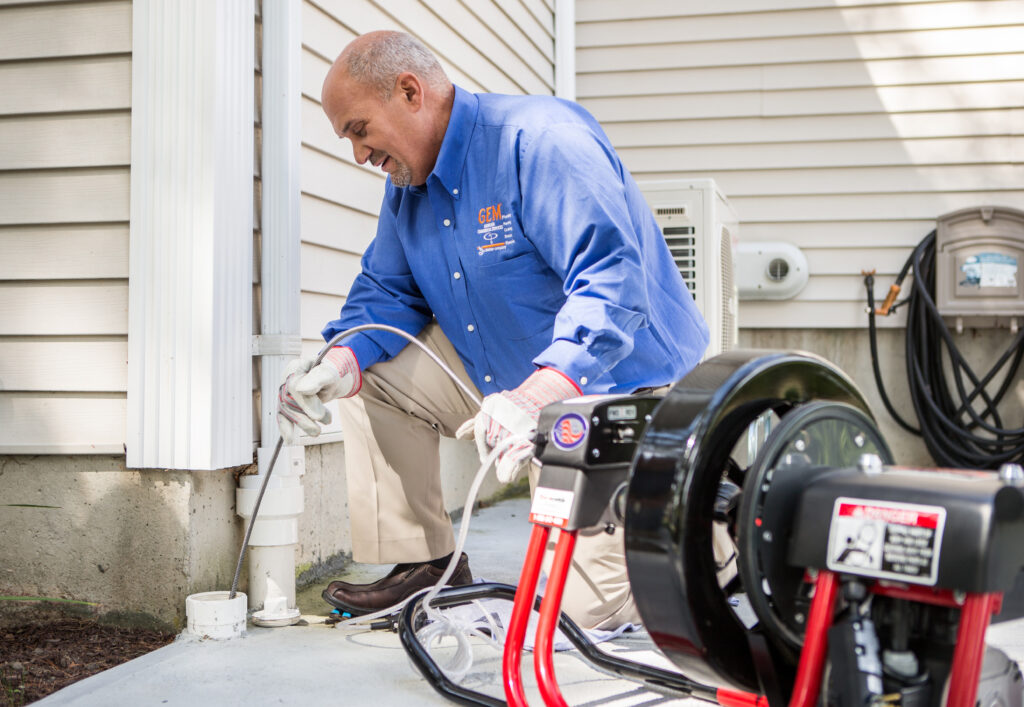
The Facility Manager’s Guide to Commercial Drain Risk
By the time water hits the floor, you’re managing downtime, tenant complaints, compliance exposure, and an insurance claim, all at once.
The buildings that avoid this treat drain infrastructure as an asset to protect, not a service call to make. GEM Plumbing & Heating, LLC tracks the condition of your systems over time, flags risk before it becomes an emergency, and helps you plan instead of react.
Most Drain Emergencies Begin Months Before Anyone Notices Them
The costliest drain failures start with a slow reduction in flow that nobody logs, a grease layer that thickens by the week, or even a root intrusion that adds a few inches a month. By the time the problem is detected, the failure has already been building for months.
Quit thinking in terms of fixing backups fast. Start looking at how much downtime, tenant frustration, and emergency spending you could eliminate if you could see the warning signs while they were still small.
That shift, from reacting to failures to managing drain infrastructure as an asset, is what separates buildings that treat every backup as a surprise from buildings that don’t.


Why Facilities Teams Choose GEM
Whether you’re looking to prevent future problems or address an urgent drainage issue, GEM is ready to help keep your business flowing.
Since 1949, GEM has been helping businesses throughout Rhode Island and Southeastern Massachusetts maintain reliable plumbing and drainage systems. With same-day availability, advanced equipment, experienced technicians, and a full range of commercial services, GEM is the trusted partner businesses rely on for drain care.
With a fleet of more than 500 service vehicles and a team of over 700 skilled employees, GEM has the resources to respond quickly and keep your facility operating efficiently.
The Cost of Waiting for the Warning Sign You Can See
Here’s the pattern behind nearly every emergency commercial drain call GEM receives: the building had warning signs weeks or months earlier. Sometimes it’s slower drainage or recurring minor odors; other times, there was a “small” backup that cleared with a single snake. Each one was treated as resolved instead of read as data.
The financial case for catching these signs early is not close:
- Deferred maintenance can cost up to 30 times more than addressing the same issue early, according to FacilitiesNet.
- Sewer backups are among the most disruptive and costly categories of water damage claims because they typically affect multiple systems and tenants at once, not a single fixture.
- Water damage is the leading cause of commercial property insurance claims, per Zurich North America, ahead of fire, wind, and every other peril category tracked.
- Every emergency call also carries costs that don’t show up on the invoice: after-hours labor premiums, tenant remediation, lost operating hours, and in many cases, a hit to the relationship with the tenant or department that got shut down.
None of this is a reason to spend more on drains overall. It’s a reason to spend earlier, on inspection and maintenance, rather than later, on an emergency response.

Call (833) 222-2953 to schedule drain services.
Questions?

What This Looks Like in Practice
Here’s what a working drain maintenance program typically includes once it’s in place:
- Inspection cadence, set by system, not a blanket schedule. High-load lines like commercial kitchens, mechanical rooms, and shared tenant stacks are camera-inspected and jetted on a quarterly to semi-annual basis. Lower-risk lines might run on an annual cycle. The frequency is set by how the line is used, not a one-size-fits-all default.
- A report you can act on. After each visit, you get findings tied to the specific line: current condition, any buildup or root intrusion, and a flag if a section is trending toward a problem, not just a checkbox that says “cleaned.”
- A running history per property. Every visit builds onto the last one. Six months from now, you’re not asking “when did we last service this,” you’re looking at a timeline that shows whether a given line is stable, degrading, or already addressed.
- Grease trap and interceptor servicing on a compliance-driven schedule. Pumping frequency is set to keep you ahead of local code requirements, not just ahead of an odor complaint.
- A single point of contact who knows your building. Instead of a new technician re-learning your property’s layout and history every visit, one team stays consistent, so findings carry context instead of starting from zero each time.
This is the operational layer underneath the partnership: what actually gets scheduled, inspected, documented, and reported, so the strategic case for asset-level management has something concrete backing it up.
Call (833) 222-2953 to schedule drain services.
Questions?
Know Your Risk Before It Becomes an Emergency
You don’t need to scrap your entire maintenance program to make this shift. It starts with a single step: scheduling a facility assessment.
A GEM facility assessment establishes the baseline your program will run on: camera inspection of your primary lines, especially kitchen, mechanical room, and shared-tenant drainage, along with a review of your current maintenance history, grease trap and interceptor compliance status, and any known problem areas your team has already flagged.
From there, you leave with a clear picture of where your building actually stands, not a generic checklist, and a maintenance cadence built around that reality instead of a one-size-fits-all schedule.
Schedule your facility assessment with GEM today, and start proactively managing your drain infrastructure.
